
elevenlabs gives you several ways to get the voice you have in mind. you can choose one from its library, describe a new one, or clone your own, then reuse it across projects.
but you may want a different way to work. maybe you'd prefer a monthly plan that doesn't charge for every character, or an editor where you can line up narration with your video. you might also want to run the speech model on your own computer.
we've compared seven elevenlabs alternatives, including rumik silk (that's us), to explain what each offers, what you'll pay, and what switching involves.
1. rumik silk
product type: text-to-speech api and voice-agent platform
recommended users: developers building voice apps, assistants, and character voices
pricing options: pay as you go and unlimited monthly plans
what is rumik silk?

rumik silk is a text-to-speech and voice-agent platform. you can generate voiceovers, stream speech in your app, or build voice agents that listen and respond to users.
silk supports languages including english, hindi, and tamil, with availability depending on the voice model.
key features
voice descriptions: the mulberry voice model accepts a voice description in the text-to-speech request. for example, "a calm british english voice, like a helpful colleague" directs the speaker's style and delivery. you can also select a named voice.
code-switching: mix supported languages within a spoken line, so a reply can follow the way your users actually talk. language and script support depend on the model you choose.
emotion and vocal sounds: the muga voice model supports emotion tags such as
[happy]and[whisper], plus vocal sounds such as<laugh>and<sigh>in the speech text.real-time streaming: send audio to your app as it's generated over a websocket connection.
how does rumik silk compare to elevenlabs?
feature | rumik silk | elevenlabs |
|---|---|---|
code-switching | ✓ | ✓ |
text normalization | ✓ | ✓ |
voice descriptions inside the tts request | ✓ | ✕ |
real-time streaming | ✓ | ✓ |
managed voice agents | ✓ | ✓ |
pay-as-you-go pricing | ✓ | ✓ |
self-serve unlimited tts plans | ✓ | ✕ |
voice cloning | ✕ | ✓ |
mulberry accepts a speaker description in the request that generates the speech. elevenlabs' voice design creates a saved voice for later requests, and its tts api also lets you adjust that voice's delivery settings per request.
elevenlabs' self-serve plans include a usage allowance, then charge for further generation. switching to a silk unlimited plan changes what you budget for: peak simultaneous requests instead of the total characters generated.
pricing
silk offers pay-as-you-go pricing and unlimited monthly plans. prices below are in usd.
voice model | price per 1,000 characters |
|---|---|
mulberry | $0.005 |
muga | $0.01 |
voice descriptions, spaces, punctuation, and inline tags count toward billed characters. pay as you go includes four simultaneous requests shared across tts and agents. international charges use inr-to-usd conversion, so your account's rate can vary with the exchange rate. see the billing details.
unlimited monthly plans
requests at the same time | monthly price |
|---|---|
1 | $199 |
2 | $399 |
4 | $799 |
8 | $1,599 |
unlimited plans have no character allowance to use up. your chosen number of simultaneous requests is shared across tts and agents. additional requests fail when every slot is busy. contact the rumik team if you need more than eight slots.
when should you choose rumik silk?
your users generate a lot of speech. if daily conversations and repeat visits keep adding to your character bill, a monthly capacity plan gives you a fixed tts cost for the number of requests you need to run at once.
you want to describe the voice you have in mind. for an app with a tutor and a support assistant, describe each role's style, accent, and pace in its text-to-speech request.
easier implementation: the api quickstart and sdk cover the first integration steps, with the rumik team available for setup questions.
bottom line
if more users keep pushing up your speech bill, choose rumik silk as your elevenlabs alternative for unlimited monthly plans priced by how many requests run at once instead of every character generated.
2. cartesia
product type: text-to-speech api and voice-agent platform
recommended users: developers building conversational apps, phone assistants, and branded voices
pricing options: monthly subscriptions with optional usage overages
what is cartesia?

cartesia provides speech models and tools for building voice apps. its sonic voice model generates speech using a voice from its library or a clone you create.
you can use sonic as the speech layer in your own app, or build voice agents with managed agents, which handles listening, turn-taking, interruptions, and tool calls around your chosen llm.
key features
library and cloned voices: choose a ready-made voice or create a custom voice from recordings, with instant and professional cloning available on different plans.
streaming text and audio: send a reply in parts as your llm writes it and receive speech over a websocket connection.
multilingual speech: sonic 3.6 supports 44 languages, including english, hindi, and tamil. it also supports hindi-english code-switching and romanized hindi.
delivery controls: adjust volume, add pauses, and guide speed through the api. speed adjustments work with instant clones. professional clones take their pacing from the recordings. emotion guidance is currently an english-only beta feature.
how does cartesia compare to elevenlabs?
feature | cartesia | elevenlabs |
|---|---|---|
code-switching | ✓ | ✓ |
text normalization | ✓ | ✓ |
voice descriptions inside the tts request | ✕ | ✕ |
real-time streaming | ✓ | ✓ |
managed voice agents | ✓ | ✓ |
pay-as-you-go pricing | ✕ | ✓ |
self-serve unlimited tts plans | ✕ | ✕ |
voice cloning | ✓ | ✓ |
both providers generate speech from a selected voice and offer controls for its delivery. that differs from describing a new speaker inside the tts request.
cartesia also offers dated model releases that stay fixed, so you can test a new sonic release before changing your production app. switching providers still means selecting or cloning voices in cartesia. your elevenlabs voice ids do not transfer.
cartesia's paid tts plans are monthly subscriptions with optional overages, rather than a subscription-free pay-as-you-go plan.
pricing
cartesia's paid plans start at $5/month for 100,000 credits, with larger plans at $49/month for 1.25 million credits and $299/month for 8 million. tts uses approximately one credit per character, with extra usage billed separately. commercial use and instant cloning start on pro. professional cloning starts on startup.
when should you choose cartesia?
you want to test model updates before releasing them. keep a dated sonic release in production while you compare the next version against your own scripts.
your assistant needs to speak while a reply is still being written. stream partial text from your llm and keep it in the same speech context, rather than waiting for the complete response.
you're launching a small commercial app. pro gives you a $5 monthly starting point with instant cloning, so you can try a branded voice before committing to a larger plan.
bottom line
choose cartesia as your elevenlabs alternative if you're building a conversational app and want streaming text input, cloned voices, and control over when your speech model updates.
3. fish audio
product type: text-to-speech api, creator tools, and hosted voice agents
recommended users: developers and creators producing character dialogue, voiceovers, and multilingual apps
pricing options: pay-as-you-go api and separate web-app subscriptions
what is fish audio?

fish audio provides speech generation and voice-creation tools through an api and a browser app. you can use it for narration, dialogue between characters, or spoken replies in your own product.
s2.1-pro is its recommended general production model, while drama 3 adds more ways to direct a performance. fish also offers hosted voice agents which is currently in public beta.
key features
voice cloning and design: clone a voice from reference audio, or describe a new voice and hear candidate recordings with your own preview text.
performance direction: with drama 3, write directions such as a nervous laugh or a quiet, reassuring delivery into the script, and change the delivery of selected words.
multi-speaker dialogue: assign different voices to characters and generate their turns in one request, rather than assembling every line separately.
real-time streaming: stream generated audio to your app, with websocket support for sending text as it becomes available.
how does fish audio compare to elevenlabs?
feature | fish audio | elevenlabs |
|---|---|---|
code-switching | ✓ | ✓ |
text normalization | ✓ | ✓ |
voice descriptions inside the tts request | ✕ | ✕ |
real-time streaming | ✓ | ✓ |
managed voice agents | ✓ | ✓ |
pay-as-you-go pricing | ✓ | ✓ |
self-serve unlimited tts plans | ✕ | ✕ |
voice cloning | ✓ | ✓ |
both fish audio and elevenlabs offer voice design, which turns a written brief and preview text into candidate audio. the description row above refers specifically to their standard tts endpoints, rather than these separate voice-design apis.
fish's elevenlabs compatibility api lets you keep using the elevenlabs sdk while trying fish's speech models. you still need fish voices, and some elevenlabs settings are ignored. some output formats also differ, so check your audio requirements before switching.
pricing
fish audio's api pricing is $15 per million utf-8 input bytes for s2.1-pro, with no subscription fee or monthly minimum. billing counts bytes rather than characters, so compare costs using your actual scripts. web-app subscriptions are separate.
when should you choose fish audio?
your characters need more than a neutral reading. direct a hesitant reply, a whispered warning, or a change in mood within the script, and assign different voices to each character.
you already use the elevenlabs sdk. the compatibility api gives you a way to evaluate fish without replacing the sdk first, while checking the voices, settings, and formats your app needs.
your speech usage comes in bursts. the api has no monthly minimum, so you can pay for generation as projects arrive instead of maintaining a paid subscription between them.
bottom line
choose fish audio as your elevenlabs alternative if you want to direct character performances in plain language or evaluate another speech provider while keeping the elevenlabs sdk.
4. sarvam ai
product type: text-to-speech api and voice-agent platform
recommended users: teams building customer calls, ivr, and apps for indian-language users
pricing options: pay-as-you-go credits and monthly plans
what is sarvam ai?

sarvam ai provides speech models and a managed voice-agent platform with a focus on indian languages. its bulbul models generate speech for customer calls, ivr, learning content, and narration.
bulbul v4 flash is recommended for new integrations and offers voices organized by language and style, including english, hindi, and tamil.
key features
voices for different jobs: choose personas for customer service, sales, devotional narration, and other uses, with the voice tied to a language and delivery style.
code-switching: mix english with supported indian languages within a line. sarvam recommends writing indian-language words in their native script and english words in latin script.
streaming speech: generate an audio file for later use, or stream speech over http or a websocket connection for live apps.
voice cloning (beta): sarvam's separate cloning api can reuse a saved voice or work from a reference recording, including across its supported languages.
how does sarvam ai compare to elevenlabs?
feature | sarvam ai | elevenlabs |
|---|---|---|
code-switching | ✓ | ✓ |
text normalization | ✓ | ✓ |
voice descriptions inside the tts request | ✕ | ✕ |
real-time streaming | ✓ | ✓ |
managed voice agents | ✓ | ✓ |
pay-as-you-go pricing | ✓ | ✓ |
self-serve unlimited tts plans | ✕ | ✕ |
voice cloning | ✓ | ✓ |
for a customer-support assistant or sales call, sarvam lets you choose from the available personas for your language and role. you select a catalog voice rather than describe a new speaker in the synthesis request, as with elevenlabs' standard tts api.
pricing
sarvam's api pricing is ₹2 (approximately $0.021) per 1,000 characters for bulbul v4 flash and ₹3 (approximately $0.032) for bulbul v3 on pay as you go, with no monthly commitment. paid monthly plans offer lower per-character rates. voice cloning currently costs ₹2 (approximately $0.021) per 1,000 characters, and managed voice-agent calls are billed separately.
when should you choose sarvam ai?
your customers mix english with indian languages. use language-appropriate personas and native-script text for replies such as an order update containing english product names.
you want a ready-made voice for a business task. pick a customer-service or sales persona and adjust the speaking pace, rather than starting by creating a new voice.
bottom line
choose sarvam ai as your elevenlabs alternative if your priority is indian-language customer conversations and a voice catalog organized by language and business role.
5. deepgram
product type: text-to-speech api and voice-agent platform
recommended users: developers building live assistants and customer calls
pricing options: pay as you go, annual prepaid credits, and enterprise plans
what is deepgram?

deepgram provides speech recognition, text-to-speech, and a managed voice agent api. you can use its speech models in an existing app or use the agent api to connect speech recognition, a language model, and spoken replies over one connection.
key features
streaming from incoming text: send text as your language model writes a reply, and flux tts starts returning audio before the full response is ready.
interruption feedback: when a caller cuts in, your app can stop playback and report how far it got. flux tts then returns the spoken and unspoken parts of the response, so you can update the conversation history.
managed voice conversations: the voice agent api handles listening, language-model integration, and speech generation, with function calls for connecting your own tools.
how does deepgram compare to elevenlabs?
feature | deepgram | elevenlabs |
|---|---|---|
code-switching | ✕ | ✓ |
text normalization | ✓ | ✓ |
voice descriptions inside the tts request | ✕ | ✕ |
real-time streaming | ✓ | ✓ |
managed voice agents | ✓ | ✓ |
pay-as-you-go pricing | ✓ | ✓ |
self-serve unlimited tts plans | ✕ | ✕ |
voice cloning | ✕ | ✓ |
elevenlabs also offers streaming and managed agents. deepgram deserves a look when your app needs to track what happened to a reply after a caller interrupted it. its interruption feedback depends on your app reporting the playback position. stopping generation alone doesn't tell it what the caller heard.
pricing
deepgram's pay-as-you-go pricing is $0.045 per 1,000 characters for flux tts, $0.030 for aura-2, and $0.015 for aura-1. growth plan offers lower usage rates with annual prepaid credits starting at $4,000. the full voice agent api is billed separately by the minute.
when should you choose deepgram?
callers often change their minds mid-reply. use the interruption feedback to update what the agent has already said before it answers the new request.
your english-speaking assistant has several back-and-forth exchanges. flux tts keeps speech state between replies instead of starting each one with fresh acoustic context.
you want one api for the conversation pipeline. use the managed agent service to connect listening, a language model, spoken responses, and your business tools.
bottom line
choose deepgram as your elevenlabs alternative if you're building english-speaking voice agents and need to keep track of what callers heard when they interrupt.
6. murf
product type: voiceover editor with a media timeline
recommended users: course creators, marketers, and teams making narrated videos
pricing options: monthly or annual subscriptions, and custom enterprise plans
what is murf?
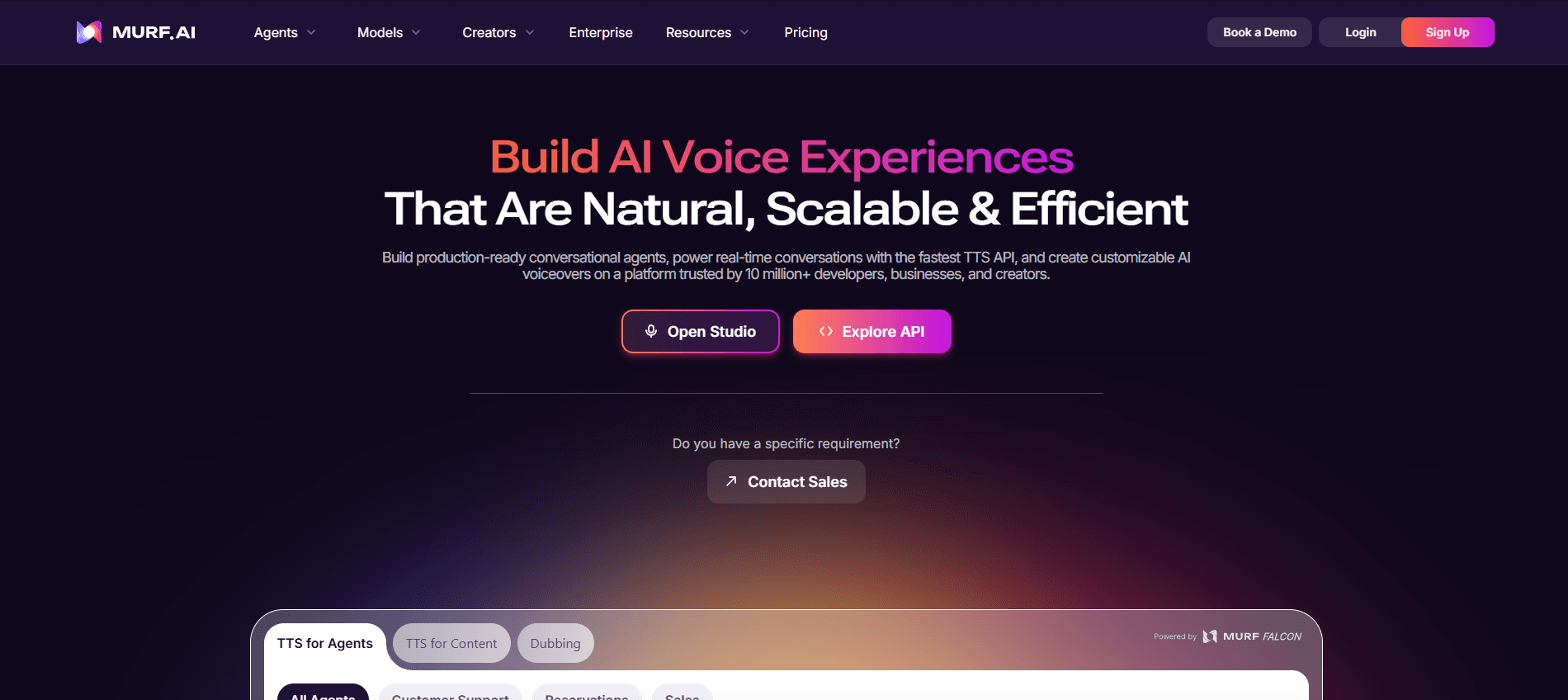
murf studio is a browser-based editor for turning scripts into narrated videos, presentations, and audio. write your script in blocks, choose a voice, and arrange the narration alongside video, images, and background music.
key features
narration and media timeline: arrange voice blocks, video, images, and music, then preview how they fit together before exporting.
word-level pronunciation controls: use suggested pronunciations, alternative spellings, or phonetic notation for names and technical terms. change the language or accent of selected words and phrases in a mixed-language script.
multinative voices: use the same supported voice across different languages, including english, spanish, and french, rather than choosing a different speaker for every version.
how does murf studio compare to elevenlabs?
feature | murf | elevenlabs |
|---|---|---|
code-switching | ✓ | ✓ |
text normalization | ✓ | ✓ |
voice descriptions inside the tts request | ✕ | ✕ |
real-time streaming | ✓ | ✓ |
managed voice agents | ✓ | ✓ |
pay-as-you-go pricing | ✓ | ✓ |
self-serve unlimited tts plans | ✕ | ✕ |
voice cloning | ✓ | ✓ |
elevenlabs studio also combines narration, video, music, and timeline editing. murf is worth evaluating if you prefer its script-block workflow and controls for individual words and phrases.
streaming and pay-as-you-go billing belong to murf's api. its voice cloning service requires an enterprise plan, and studio's unlimited generation is also an enterprise offer. unlimited downloads on a standard paid plan don't mean unlimited speech generation.
pricing
murf studio's creator plan costs $29 per month for two hours of voice generation, or $228 billed annually for 24 hours a year. business costs $99 per month for eight hours and adds controls such as "say it my way". the free trial includes 10 minutes of generation, with no downloads or commercial rights.
when should you choose murf studio?
you're making videos from scripts you already have. edit the narration in blocks and check its timing against your footage, images, and background music.
your scripts contain names, jargon, or phrases in another language. adjust the pronunciation of selected words and apply corrections across the project.
you know how a line should sound but can't get there with sliders. on a supported paid plan, record the delivery you want and use say it my way to guide the ai voice.
bottom line
choose murf studio as your elevenlabs alternative if you want to produce narrated videos from editable script blocks and control how specific words and sentences are spoken.
7. chatterbox
product type: open-source text-to-speech models
recommended users: developers who want to run and modify speech generation on their own infrastructure
pricing options: you pay for the hardware and operation
what is chatterbox?
chatterbox is a family of open-source speech models from resemble ai. you download the code and model weights, generate speech on your own machine or server, and decide how your app uses the output.
the family includes english models such as turbo and nano, plus multilingual v3 for speech across languages.
key features
voice cloning from a recording: supply a reference clip to generate new speech in that voice without training a separate model for each speaker.
model choices for different hardware: nano supports cpu inference for smaller local setups, while turbo is an english option for applications where generation speed matters.
multilingual speech generation: multilingual v3 supports languages including english, hindi, and french. choose it for language coverage. turbo and nano are english models.
control over delivery and code: turbo and nano accept inline reactions such as laughter and chuckling. the original and multilingual models offer emotion-intensity controls, and you can inspect or change the implementation.
how does chatterbox compare to elevenlabs?
feature | chatterbox | elevenlabs |
|---|---|---|
code-switching | ✕ | ✓ |
text normalization | ✕ | ✓ |
voice descriptions inside the tts request | ✕ | ✕ |
real-time streaming | ✕ | ✓ |
managed voice agents | ✕ | ✓ |
pay-as-you-go pricing | ✕ | ✓ |
self-serve unlimited tts plans | ✕ | ✕ |
voice cloning | ✓ | ✓ |
the reason to choose chatterbox is control over where generation runs and how the software works. you can change the code and build your own service, but your team takes on serving, capacity, updates, and monitoring.
pricing
chatterbox is free to download and use under the mit license, including commercially. there is no character fee for running it yourself. your costs come from hardware or cloud compute, storage, and the engineering work to maintain the service.
when should you choose chatterbox?
you need speech generation on infrastructure you operate. keep the model and generation process on your own machines, with your team controlling how the app handles scripts and reference recordings.
you want to change the software behind the voice. inspect the inference code, add your own text-processing rules, and build the serving interface your app needs.
you generate enough speech to evaluate running it yourself. compare measured throughput and infrastructure costs against your current bill before committing to the switch.
bottom line
choose chatterbox as your elevenlabs alternative if you want open-source voice cloning on your own infrastructure and have the engineering capacity to run it.
which elevenlabs alternative should you choose?
start with the reason you're considering a switch:
rumik silk if you want natural multilingual speech and code-switching, with unlimited plans priced by how many requests run at once.
cartesia if you're building a live voice app and want cloned voices and control over when your speech model updates.
fish audio if you want to direct character performances or try another speech provider while keeping the elevenlabs sdk.
sarvam ai if your customers speak indian languages and you want voices suited to support calls, sales, or ivr.
deepgram if your english-speaking agent needs to track how much of a reply played before a caller interrupted.
murf studio if you're producing narrated videos and want to edit the script, voiceover, and media together.
chatterbox if you want to run and modify speech generation yourself, and can take on the infrastructure and maintenance.
is rumik silk right for you?
rumik silk is an elevenlabs alternative i'd recommend if:
you want a team that takes initiative. rumik is a small, hands-on team that makes your company's needs a priority, takes ownership of your questions, and works with you to get things moving.
you want to judge the voice for yourself. try your own scripts in the rumik playground before changing your app's integration.
you want an easier switch. the api quickstart and sdk give you integration examples to build from, so you can try silk in your app before committing to a full migration.
start building with the api quickstart.

